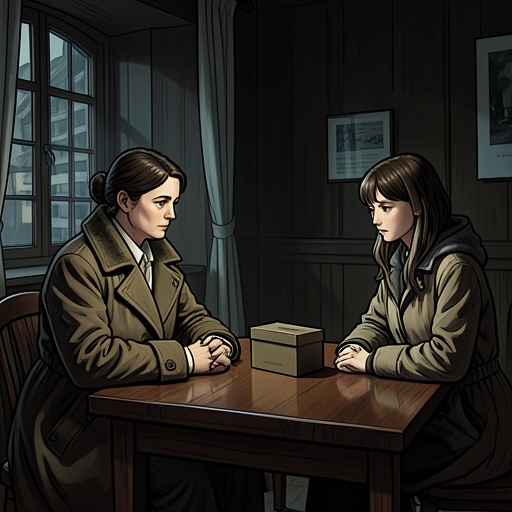
Susan Loriman is raped and kills her attacker
Hold TightSusan Loriman’s rape and the killing of her attacker are revealed not as a public case or a confession to her husband, but as a private history she has carried forward. The police never come to her, and the attacker’s death is attributed to a possible robbery or drug deal. Susan’s decision to keep the truth from Dante and their children turns the assault into a secret with a long domestic afterlife: she continues her marriage and family life, but the trauma alters her relationship to sex, to men’s attention, and to what she can disclose even when asked for help.
The assault and the unanswered aftermath
The account establishes the central facts without detailing the mechanics of the rape or the attacker’s death: Susan was raped, and the man who assaulted her is dead. Rather than seeking help from him, she later recognizes that there is no point; he cannot be asked to assist her because he is gone. The passage does not describe how Susan killed him, and the circumstances of his death remain distinct from the account the authorities accept.
Susan waits for the police to come to her, but they never do. She reads about the dead man in the papers and sees his name. The stories last only a day or two, and the police suspect he died in a robbery or a drug deal gone wrong. His criminal record makes that explanation plausible to them. The investigation therefore passes near Susan’s truth without reaching it: the man’s death is reported, but the rape and her connection to him remain outside the public account.
A secret kept for the family
Susan’s mother urges her to protect her family by keeping the assault from Dante. Her counsel is based on the fear that disclosure would permanently change how a husband sees his wife, even if he believed her. Susan follows it. When Dante comes home, she makes love to him despite not wanting to; she loves him and wants him to be happy. The distinction between affection and desire becomes part of the cost of concealment.
Dante notices that Susan is more sullen, but seems to understand that he should not ask why. The silence is therefore not simply an absence of visible change: it registers in their marriage, while remaining unnamed between them. Susan returns to church, believing her mother was right that the truth would destroy the family. She carries the secret to protect Dante and their children, treating continued family life as the reason not to speak rather than as proof that the assault has left her untouched.
The trauma’s continuing effects
Time makes the memory less continuously present, but does not undo its effects. Susan sometimes goes whole days without thinking about that night. At the same time, she still does not like sex, and admiring looks from men, which she once welcomed, now make her stomach hurt. These changes show the assault persisting in ordinary experience: not as a single public crisis, but as a lasting alteration in what intimacy and attention feel like to her.
The account also makes clear that keeping the secret has limits. Susan cannot tell Ilene Goldfarb the truth when the possibility of asking the attacker for help arises, because he is dead. That fact closes off a route to assistance while exposing the gap between the visible case and Susan’s private knowledge. Her silence has protected her family from a truth she believed would destroy it, but it has also left her to carry the consequences without Dante’s understanding.
Narrative significance
The revelation recasts Susan’s changed behavior as the aftermath of violence rather than an unexplained change in temperament or marriage. The contrast between the brief newspaper coverage of the dead man and the years of private consequences underscores how little the public account contains. The police’s suspected robbery or drug-deal explanation concerns the circumstances of his death; it does not disclose what happened to Susan or what she has endured since.
The event also gives weight to Susan’s inability to speak openly with Ilene. Her refusal is not presented as indifference to help: the person she might have asked is beyond reach, and the secret has been shaped by her fear of what disclosure would do to her family. The revelation leaves the assault unresolved in the sense that its effects continue, even as Susan has built a life around its concealment.